Showing posts with label cotton. Show all posts

Thursday, March 26, 2026

Weaving Class Tote, part 2

The bag on the cover of the Spring 2025 issue of Little Looms was the goal.


Not too shabby.


But getting there was rather painful. After struggling with the instructions, the handwoven material, my lack of sewing skills, etc., I decided to make a practice bag. This helped immensely. Then I basically tore apart what I had accomplished so far and started over with the sewing of the handwoven. My seam ripper and I really got to know each other during this phase.


This inkle band is more substantial than the one for the practice bag, but I think it too is a bit flimsy. Annie MacHale weaves guitar straps using Sinfonia mercerized cotton; in the future, I will do the same when I want something more firm.


While the foam stabilizer was easy to sew through, tension problems arose when the layers included not only the handwoven, the foam, and the cotton lining, but the inkle band as well. Some have suggested using a "walking foot" (whatever that is) to remedy this.


Pattern: Weaving Class Tote, by Michele Marshall from the Spring 2025 issue of Little Looms
Weave structure: plain weave
Loom 1: Ashford rigid heddle 24"
Warp: 8/2 cotton in colors as close as I already had without buying (too much) more
Weft: 8/2 cotton in white
EPI/PPI: 12.5/11
Ends: 250 doubled, so 500
Loom 2: Ashford inkle loom
Warp: 8/4 cotton rug warp in colors I already had without buying (too much) more
Weft: 8/4 cotton run warp in white
EPI/PPI: 39/9
Ends: 73


This weaving project is the most ambitious one I have tried so far, but I learned a lot. When I recover, I hope to sew more bags, from both handwoven and commercial fabric.

Tuesday, March 24, 2026

Weaving Class Tote, part 1

The more one weaves, the more one feels comfortable with the whole process. And the more one views videos on line, reads blog posts, and shares with fellow weavers, the more one incorporates new and better ways of doing things. This project is an example of that process.

8/2 cotton, doubled for warp and weft

While idly watching a YT video on weaving towels, I noticed the weaver did two things that I've added to my repertoire: attach the back warping stick to the heddle to keep them steady and use multiple "pegs" when warping.

Steady as she goes

Repurposed coat rack

After a few false starts with warping, I thought (rather smugly) I was well on my way. But then I discovered I was reading the warping chart incorrectly. Could I just forge ahead? No, the stripes on the bag would look all wrong. So I removed those errant warp threads and started over.

Then, while winding the warp onto the back beam, I found two broken warps. WTH?!? Fortunately, they both were at one edge, so I just knotted them together and hoped they would be hidden when the sides were joined.

I use different methods for tying onto the front beam. This one usually gives me the best tension all the way across the warp.


Once the warping was done, the weaving went fairly smoothly. I attached a measuring tape to keep track of my progress.


After I finished weaving the straps on my inkle loom, both the straps and the fabric went into the washing machine for a good dunking, then into the dryer. This "sets" the weave of the cotton yarn well.


The fabric and straps sat for quite a while after this, while I got up the gumption to actually sew the bag. What motivated me was an upcoming weaving guild program on making bags and purses with handwoven. See part 2.

Friday, February 06, 2026

McDonald Dishcloths

I dyed some cotton yarn with the leftovers from the tie-dye program I presented at the spinning guild. The colors remind me of the corporate colors for McDonald's, hence the name. I am in no way encouraging anyone to actually eat there.


Pattern: none
Yarn: Peaches & Creme Original Solids, hand-dyed
Needles: US7


For the diagonal one, I cast on three stitches, knit a row, then K1, YO, K to last stitch, YO, K1, turn and knit back. When the stitch count reached 47, I knit two rows, then begain the decreases: K2tog, YO, K2tog, K to last 4 stitches, K2tog, YO, K2tog, turn and knit back. When back to three stitches left, bind off.


For the second one, I cast on 32 stitches (long tail), knit back and forth until I was almost out of yarn (which happened to coincide with where the dishcloth formed a square), then bound off.

My kids claim they need no more dishcloths, but I still like to have a couple on hand, just in case.

Monday, December 29, 2025

Leno curtains

These curtains have been a long time coming. My goal was to have a pair of lacy panels to hang in my bathroom window, something that would let some light in while obsuring the interior. Those objectives appear to have been met with the leno weave structure, although I should view them from outside after dark, to see just how obsuring they are when the light is on.


Pattern: none
Weave structure: leno
Loom: Ashford 24" rigid heddle
Warp: Valley Yarns Cotton 3/2 (which is mercerized), in 2550 ('Nautical Blue')
Weft: Same as warp
EPI/PPI: 10/10-ish
Ends: 236
Finished size: 41"/44"L (from rod pocket fold to top of hem fringe), 20"W Finishing: Phillipine tie at rod pocket, twisted fringe at hem.

Using a temple to maintain the selvages, I started weaving them in January of 2022, and the first panel came off the loom in February, the second in March. After a long hiatus (until April 2025), I twisted the fringe at the bottom.


This past month, I created the rod pocket by folding the top and tying the fringe onto the main body of the fabric (as opposed to simply sewing the rod pocket), then finished by using the Phillipine Tie to make things look tidier.


Due to uneven beating, the two panels are different lengths. I'm hoping a few steamy showers will relax the fabric a bit so they hang straighter.


They are far from perfect. If I were to redo this project, I would be more careful about length (they are too long to cover half the window, too short to cover the entire window, hence the 3/4 coverage). I would also make more of an attempt to beat evenly, by measuring my progress with more precision. Live and learn.

Tuesday, September 30, 2025

Softest Cotton Bathmat

It's not unusual for me to knit with cotton in the summer heat. No one wants dishcloths anymore, so I wound up knitting this bathmat. It wasn't a difficult knit, but I'm glad I didn't have to undo any of it because the "eyelash" bits obscured everything else.


Pattern: Softest Cotton Washcloth + Bath Mat, by Purl Soho
Yarn: Purl Soho Witch Hazel in 'Classic Denim'
Needle: US8 (started with DPNs, switched to 16" circs, then 24" circs, finished with 60" circs)
Modifications: None except to use a suspended bind off, which was a bit too loose and left the edges a bit ruffle-y.


I'm not sure why I picked blue, since it was destined for a bathroom that's mostly green. I purchased an extra ball, but did not use as much as the pattern said, so now I have 2 extra balls, enough to knit some washcloths as well, which will also be the wrong color for that bathroom.


The bathmat *is* very soft. My only concern is there is no non-slip backing on it. Not sure how I would remedy that. Suggestions?

Friday, August 29, 2025

Kit & Caboodle tote

This project exercised my brain a bit. A comment about there being barely enough yarn from two skeins encouraged me to purchase an extra skein, which came in useful for swatching so I could practice the one-step provisional cast-on and the right- and left-twist stitches.


Project: Kit & Caboodle tote from Purl Soho
Yarn: Purl Soho Sunshower Cotton, in 'Bright Watermelon'
Needles: US8
Modifications: None.

The pattern is very easy to understand, even the attached i-cord instructions. There are alternative instructions if you just don't want to try the one-step provisional cast-on, and there is an online tutorial at Purl Soho if you do.


My only reservation is if the i-cord straps will be sturdy enough or will they stretch? Ditto the fabric. A few items seem okay, though. It would definitely work as a project bag.


I blocked the tote in hot tap water, then ran it through the dryer. It came out still damp and took *forever* to air dry.

Wednesday, July 30, 2025

Playing with clasped-weft weaving

Several years ago, the program at our local weaving guild was about clasped-weft and clasped-warp weaving. Even though it may seem like I am not paying attention, I really am. This summer I decided to play around with the clasped-weft method.

Clasped-weft weaving results in a mostly weft-faced fabric. When executing the clasped-weft rows, each pass has double the weft. This left me questioning what to do with the rows of just one color. Sometimes I wove with just one strand, other times tried it with two. The results look different, but not necessarily wrong.

My efforts were based on a pattern in The Weaver's Idea Book, by Jane Patrick, called "Summertime Coasters". For warp, I used some Maurice Brassard 8/4 cotton warp (colorway 'Linen' I think). For weft, I started out with Tahki Stacy Charles Cotton Classic 100% Mercerised Cotton, in 'Milk Chocolate', 'Raspberry', and 'Leaf Green'. The yarn is a bit springy, if you know what I mean, and I had a hard time beating it down with the heddle alone.

.
Then I switched to Pisgah Peaches & Creme Ombres ('Spring Meadows'), Lion Brand Lion Cotton Solid in white, and Den-M-Nit Pure Indigo Cotton (dyed). Although all are rated as worsted, the denim yarn is on the light side, yet it seemed to work okay with the heavier worsted.


By now I was getting the hang of things, including beating the weft with a fork to pack it down better. These are in the Den-M-Nit Pure Indigo Cotton (dyed and undyed).

Ordinarily, I don't use hemstitch for securing the warp fore and aft, but this time got in a lot of practice. A couple of these examples show you how it looks when you do it wrong, which forced me to learn to do it right.

These coasters were made on my Ashford SampleIt 9" loom, which is becoming my favorite loom of all.

Friday, July 11, 2025

Seven-strand bathroom rug

When I get a little twitchy about how much yarn I own, a stash-buster relieves some of that angst. This rug used up a LOT of cotton yarn - 1210g - including some that was leftover from frogging a pair of curtains I knit (before I knew how to weave) that had faded badly on one side.

It measures 24"x32" and turned out a little wonky. I didn't keep good notes along the way as I was just winging it, didn't even record the hook size. Basically, I crocheted a chain, single crocheted each row until it felt almost big enough, then crocheted around the border a couple of times. I didn't even try to weave in any ends, just tied on new bits as needed and let the tails add "texture".


Crocheting a 7-strand anything involves a lot of yarn wrangling. A "lazy Kate" made from a shoe box and knitting needles helped, as did having three yarn bowls. The basic structure consisted of:
  • 2 strands Den-M-Nit Pure Indigo Cotton yarn and 1 strand Universal Yarn Linen Tweed (red) throughout
  • 1 strand of cotton thread throughout (first blue, then natural) - J&P Coats Royale Classic Crochet Thread (size 10)
  • 1 strand worsted weight cotton yarn throughout - first Lily Sugar'n Cream Stripes ('Country Stripes'), then Pisgah Peaches & Creme Ombres ('Spring Meadows')
  • 2 strands Maysville 8/4 Cotton Carpet Rug Warp throughout (navy, red, pink, yellow, etc.)

Crocheting something that bulky is very hard on my wrists. And yet, I can envision doing it again, maybe with leftover sock yarns.

Tuesday, October 25, 2022

Seed stitch dishcloths

For some reason, probably because of the heat and humidity, I don't like to knit wool during the summer even though I have an air conditioned house that protects me from the elements. Instead, I gravitate to cotton. Well, summer is over, and so is the cotton knitting.


Pattern: Alaina's Simple Seed Stitch Dishcloth, by Alaina Privette
Yarn: Pisgah Yarn and Dyeing Co. Peaches & Creme Ombres, in 'Shaded Pastels'
Needles: US7 (cast on and bind off with US8)
Modifications: None


It feels like knitting seed stitch takes twice as long as just knitting or just purling, as the yarn has to be moved front-to-back or back-to-front for each stitch. But once you build up a rhythm, it doesn't seem so bad.


There is a stack of handknit dishcloths by my front door, free to visitors, but apparently I have saturated the market. I still have a LOT of worsted weight cotton that doesn't seem suitable for much of anything else, but I will put a pause on dishcloths for a while.

Friday, October 21, 2022

Garter dishcloths on the bias

When I decided to knit more dishcloths in garter, but on the bias, I tried to wing it at first. After all, one of my first knitting projects was a dishcloth. But for some reason, it was not working out very well. So I found a simple pattern that someone else had figured out.


Pattern: Garter Stitch Dishcloth, by Joan Janes
Yarn: Pisgah Yarn and Dyeing Co. Peaches & Creme Ombres, colorway '130 Shaded Pastels'
Needles: US7
Modifications: None


This was more TV watching knitting, a great distraction from the incessant, repetitive commercials. (If "they" know so much about us, how come the only commercials I see are for products that I am not interested in and/or that don't apply to me for a variety of reasons?)


I recently sorted through a drawer of finished objects and came across quite a few dishcloths from an earlier era. So now there is a growing pile on the "gift table" near my front door. Just in time for the holidays.

Tuesday, September 20, 2022

Garter dishcloths

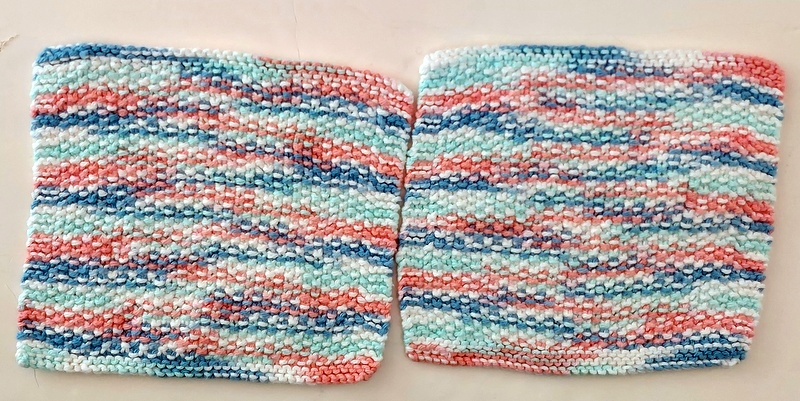
I'm not much of a TV watcher, but I do stream some favorite shows. I'm too cheap to pay extra to eliminate commercials, but find them to be tedious and boring. Enter simple knitting. These garter stitch dishcloths are perfect for bridging the gap.

Pattern: none; just cast on 40 stitches, knit until the piece looks squarish, then bind off.
Yarn: Pisgah Yarn and Dyeing Co. Peaches & Creme Ombres, colorway '130 Shaded Pastels'
Needles: US7 (but cast on and bound off with US8)


I'm always a bit reluctant to use a colorway that includes white or natural for dishcloths, as once the dishcloths get used, they get a bit dingy. But I have a lot of cotton yarn like this and plan to use it up one way or another.


Once upon a time, I knit a towel, but that took *forever*. Dishcloths are just the right size for a simple knitting project.

Tuesday, August 16, 2022

Waffle weave towels in red

I wove some waffle weave dishcloths a while back and found them a fun weave, so I decided to make some kitchen towels. The pattern called for blocks of color, but sometimes I think patterns in magazines are deliberately designed to try to force the weaver to buy a LOT of yarn. I am more interested in the weave structure than the colors, so I wove these in my favorite color: red.

Waffle weave is a loose weave structure. I discovered that, when hand hemming these towels, I had to stitch into the weft, not the warp, as the warp would pull out. Also, this weave structure shrinks a LOT when washed. The beginning size was approximately 30"x17", unhemmed.


After running the hemmed towels through the laundry, they measured approximately 23"x16" (the pattern indicated 24"x16.5", so very close). They have a lot of drape, too, probably because I did not beat hard enough to achieve 20 ppi that the pattern indicated.


Pattern: Playing with Blocks: Waffle-weave Towels, by Jodi Ybarra, as printed in the Holiday 2020 issue of Easy Weaving with Little Looms
Modifications: Used single yarn for weft while weaving the hems
Weave structure: Waffle weave
Loom: Ashford 24" rigid heddle
Warp: Valley Yarns 8/2 Unmercerized Cotton, in red (3611), doubled
Weft: Valley Yarns 8/2 Unmercerized Cotton, in red (3611), doubled
EPI/PPI: 12.5/10ish
Ends: 256
Off loom size, unhemmed: 30"x17"
Finished size, hemmed: 23"x16"

Before washing, the waffle looked good, but afterwards, a strip of non-waffle appeared in the middle of the towels. I must have done something (consistantly) wrong there, maybe caused by a loose warp thread.


All in all, though, I'm pretty pleased with the result, have plans to weave more. However, I think I favor 8/4 cotton over 8/2 doubled.


Weavers like to participate in tea towel exchanges and compete (nicely) to outdo each other. My towels will never qualify as fancy-schmancy, but they are very functional.

Thursday, June 23, 2022

Leno and Brooks Bouquet sampler

I wanted to weave some curtains, but couldn't decide whether to make them using leno or Brooks bouquet. To help me make up my mind, I created a sampler of both, using the Ashford SampleIt loom with a 10-dent heddle, out of 3/2 mercerized cotton. For some reason, I photographed the sections in the reverse order than I wove them in, but I'm sure you will get the idea.

Doup leno without doups
Doup leno
Leno - Jane (Patrick) variation
Cheater bouquets without ties
Cheater bouquets
Ladder hemstitch - 2 warps
Ladder hemstitch - 4 warps
Brooks bouquet staggered over Brooks bouquet
Leno 2x2 continuous over Leno 2x2
Leno 1x1 continuous over Leno 1x1
Put it all together

In the end, I used the doup leno without the doups for my bathroom curtains. Doups are basically string heddles, and in this instance, I found them more trouble than they were worth. I also forgot to enter this project into Ravelry (now rectified) and didn't take very good notes, but was able to figure out what was what based on a fiber "log" I keep. I'm still thinking of using Brooks bouquet for some kitchen curtains, and my SO likes the ladder stitch patterns, so this sampler will come in handy for several projects.

(References: Inventive Weaving on a Little Loom, by Syne Mitchell, and The Weaver's Idea Book, by Jane Patrick.)