I'm wondering what exactly is the impetus that drives me to make more fiber and fiber-related purchases. Perhaps because my doctor told me that the likelihood of my having a stroke or heart attack was remote? As if I don't already have a lifetime of fiber.
At least not all my purchases at the Jay County Fiber Fest were fiber; some were ceramic. One thing I was looking for was silk thread, but one vender suggested I try a specialty quilting shop for that. I'm always on the lookout for unusual tools, but did not find any this time.
I'm discovering that one cannot have enough yarn bowls, especially if one has more than one project in progress and/or one knits at different locations in the house. I have one by my TV chair, and now I have one for the coffee table in the livingroom. This one was made by one of my fiber/ceramic friends.
Another ceramic friend, Elizabeth Wamsley, made this sweater-like cup. I've been considering making something similar, so it is good to have a model for inspiration.
I started a narrow tapestry to record things that occur during the year, but I don't have a lot of the colors I want to use. These small cakes of pencil roving should help there.
Another fiber friend who hosts our Fifth Saturday Spin-ins had a basket of these pastel samples. I think they will help with the above mentioned tapestry as well.
I can't resist red, so I grabbed up some silk sari yarn. The price seemed a bit high to me, but the vendor dyes the skeins herself, plus the ones I picked had more yardage than some of the others.
I certainly do NOT need any more sock yarn, but this brightly colored skein sparkles. There were more colorways calling to me, but I resisted.
The estate sale fiber and equipment will again be available at the next spinning guild meeting. If the package I picked up and put back last time is still there, it just might follow me home.
Showing posts with label fiber festival. Show all posts
Monday, March 11, 2024
Saturday, May 14, 2022
I spun and spun and spun some more
Yesterday morning I worked my shift at the Salomon Farm Fiber Fest, for the spinning guild. I can't recall the last time I attended this fiber fest, so it felt a bit new to me, plus I think it was downsized? Anyway, I arrived early enough to help set up, then parked my butt in a very uncomfortable folding chair, and spun and spun and spun.
Besides me and my wheel, there were several volunteers showing kids how to hand card fleece and spin it into yarn using a spindle. Since it was a Friday, the clientele was mostly home school kids of all ages, and their parents, although there were a few adults without children as well.
I didn't have a spiel prepared, but after a while I developed a patter about what I was doing. I also answered random questions about the displays. In the future I think it would be helpful to have a volunteer to "man" the displays, to answer questions and point out exactly what they are looking at (like the live silk worms).
At lunchtime, I quit for the day, but then had to visit the other displays. The weaving guild was there, as well as quilters, a flax demonstrator, a goose quill demonstrator, a knitting guild with various knitting machines, etc. Many of the demonstrators are involved in multiple guilds, which explains why it is so hard to find volunteers to work the festival. And it also explained why I was still there two hours later, because I had to talk to everybody.
Besides the demonstration area, there were vendors. I took a quick tour but managed to get out of there without buying any fiber. In fact, I got rid of two of the fleeces in the garage, as someone needs dirty fleeces to test some machinery that will turn waste wool into something for gardening? I didn't catch exactly what the purpose was, but was happy to provide some raw material for the effort. Those fleeces were free and have been weighing on my mind. I felt I should process them or have them processed, but the one free fleece I did clean and card turned out to be of poor quality. I didn't want to spend a lot of time and/or money on something that might be a disappointment. I still have a Jacob fleece to play with; I purchased it locally and trust the provider.
Knitting: I finished the cowl; separate post to follow. The Habitation throw is out of time-out; apparently, I just can't count.
Spinning: See above.
Weaving: I started warping the Ashford 24" rigid heddle for some waffle weave towels.
A common weaving problem is measuring one's work as one goes along; dressmaker measuring tapes are usually too short. One solution is to make one's own paper tapes, which I did last week. It was a bit tedious, but now I have a collection of tapes that are over 12 feet long.
I used some kraft paper that came as padding in a package, not realizing that there were perforations every 8 or 9 inches. So besides all the measuring and marking and cutting, there was Scotch taping as well. In the future, if I need to repeat this task, I'll buy some kraft paper.
![]() |
| Natural dyeing display |
Besides me and my wheel, there were several volunteers showing kids how to hand card fleece and spin it into yarn using a spindle. Since it was a Friday, the clientele was mostly home school kids of all ages, and their parents, although there were a few adults without children as well.
![]() |
| Sheep breeds and flax info |
I didn't have a spiel prepared, but after a while I developed a patter about what I was doing. I also answered random questions about the displays. In the future I think it would be helpful to have a volunteer to "man" the displays, to answer questions and point out exactly what they are looking at (like the live silk worms).
![]() |
| We lost the F's somewhere along the way |
At lunchtime, I quit for the day, but then had to visit the other displays. The weaving guild was there, as well as quilters, a flax demonstrator, a goose quill demonstrator, a knitting guild with various knitting machines, etc. Many of the demonstrators are involved in multiple guilds, which explains why it is so hard to find volunteers to work the festival. And it also explained why I was still there two hours later, because I had to talk to everybody.
![]() |
| Silk display, including live worms |
Besides the demonstration area, there were vendors. I took a quick tour but managed to get out of there without buying any fiber. In fact, I got rid of two of the fleeces in the garage, as someone needs dirty fleeces to test some machinery that will turn waste wool into something for gardening? I didn't catch exactly what the purpose was, but was happy to provide some raw material for the effort. Those fleeces were free and have been weighing on my mind. I felt I should process them or have them processed, but the one free fleece I did clean and card turned out to be of poor quality. I didn't want to spend a lot of time and/or money on something that might be a disappointment. I still have a Jacob fleece to play with; I purchased it locally and trust the provider.
Knitting: I finished the cowl; separate post to follow. The Habitation throw is out of time-out; apparently, I just can't count.
Spinning: See above.
Weaving: I started warping the Ashford 24" rigid heddle for some waffle weave towels.
A common weaving problem is measuring one's work as one goes along; dressmaker measuring tapes are usually too short. One solution is to make one's own paper tapes, which I did last week. It was a bit tedious, but now I have a collection of tapes that are over 12 feet long.
I used some kraft paper that came as padding in a package, not realizing that there were perforations every 8 or 9 inches. So besides all the measuring and marking and cutting, there was Scotch taping as well. In the future, if I need to repeat this task, I'll buy some kraft paper.
Tuesday, March 22, 2022
One-pot rainbow dye workshop
Before setting my alarm clock the night before, I double checked the starting time for the one-pot rainbow dye workshop at the Jay County Fiber Fest. However, I neglected to check the list of things to bring. I remembered the $50 materials fee, but forgot to bring a pot, optional gloves, or an apron. I was not the only one in this predicament, and fortunately the instructor had a few extra pots, one of the other participants brought extra gloves, and I managed to keep the dye off my clothes. Whew!
Christinia Drennen Coghill is certified in the Redding Method of dyeing. She provided us with a handout of what the Redding Method entails, but for the purpose of the class, we just needed to do what she told us.
We each worked on an individual burner with a selection of powdered dyes and fiber. There was roving, clean raw wool, and unclean raw wool. Christina wasn't sure about the breeds, but she had us add the different fibers in a certain order. I don't think it mattered much as I doubt I would dye such an eclectic bunch of samples at one time.
The dyes were Pro Chemical & Dye WashFast Acid dyes, in yellow, green, red, orange, blue.
One trick to this method is to not have too much water; otherwise, the dyes will migrate too far and you'll wind up with one muddy color. Another trick is to use a metal chopstick to keep the simmering water from bubbling too much in the center; otherwise, you'll end up with felt.
I've been to dyeing workshops where we add a "glug" of vinegar to the water to help set the colors, but this is the first one where we also added a "glug" of shampoo. The idea here is that you can clean and dye the fiber at the same time. It seemed to work just fine, but the fiber wasn't all that dirty to begin with.
Once the water and fiber reached an almost-too-hot-to-touch temperature, we added the colors in pie-shaped proportions, using wood or metal chopsticks. The technique is to add the powdered dye near the center but not at the center, then feather it toward the outside edge, being careful not to get each color too close to its neighbor. The order was important: yellow first, then blue, then red, then orange, then green. The red and blue are really dynamic and will take over the pot if you are not careful.
Once you are satisfied with your pie wedges, you work the colors toward the center and toward the edges, so that there is no white showing. Below, Christina's pot is on the left, another participant's is on the right, and my messy attempt at being "artistic" and "experimental" is in the center.
At this point, we turned off the burners and went shopping and ate lunch while the pots cooled. Once we could handle the fiber, another glug of shampoo was added and we repeatedly rinsed and spun the results, using salad spinners. And that was it. At home, I rinsed my fiber again before spreading it out to dry under a ceiling fan.
My initial impression was that I used too much water and not enough dye, as the colors looked more pastel than saturated. I ran the fiber through a drum carder, and it looks like green and orange dominate. I'm not too thrilled with this outcome as it reminds me of Kook Aid.
Since I still had some dye left over, I decided to repeat the process with yarn. Using Cascade 220 blanks, I soaked the yarn, heated it up, and added wedges of dye. (And it just occurred to me that I forgot the glug of vinegar.)
While I think the ratio of water to fiber was better this time, I didn't use enough dye to really saturate the yarn.
So I tried it again with better results.
And then I stopped because how much rainbow fiber does one need? Some day I will spin the fiber from the workshop and depending on the results, I may overdye it.
So what did I learn? Acid dyeing is really, really easy compared to dyeing with natural materials, and the colors can be more vibrant and less experimental. Roving and raw fiber are tricky to work with, so I think I will stick to dyeing yarn. And I don't really like the idea of cleaning the fiber and dyeing it at the same time, but that's just me.
Tuesday, March 15, 2022
Jay County 2022
I think the last time I actually left town was last November, for the trip to the Wabash Woollen Works (which I have yet to blog about - bad fiber blogger!) The drive between here and Jay County is pretty boring - very flat farmland for the most part - but one is kept awake by the possible need to pass a slow moving Amish buggy. The marshland near Geneva usually smell like rotten eggs, but I didn't notice it this trip.
The primary activity at fiber fests after workshops is shopping. One doesn't need to go to a fiber fest to find these long needles, but I was there and so were they, so I grabbed the last of them from Copper Centaur Studios of Anderson.
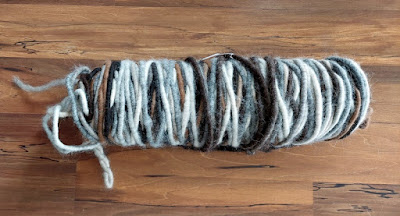
I need more yarn like I need a dropped stitch, but I could not resist these "beehives" of wool, especially after the seller, Wayne Trace Farms, dropped the price by about 30%. They are from Blue Sky Fibers, called Woolstok Jumbo, and the colorways are Gray Stone, Arctic Cloud, and Snow Storm. They are crying to be made into a jumbo tapestry.
I have SO much rug yarn awaiting to be woven that I did not need this alpaca cotton core "skein" but I bought it anyway, just because I like the color combination. I didn't get the story behind it other than the fiber content.
I also do not need an apron, but I could not resist this handmade, reversible one made by Phia who owns the Little Shop of Spinning in Roanoke IN. Besides being cute, it is long enough to actually be practical for fiber prep. Also, her husband Mark was very persuasive.
I am really bad with names and faces, and managed to embarrass myself while at the Wayne Trace Farms booth. Wayne Trace is a street in Fort Wayne, so I asked if they were from here. Why, yes, yes they are. I then asked if they were familiar with the spinning guild. Why, yes, yes they are. In fact, one of them is a co-president of the guild. I think this is the first time I have seen Case without her mask, but one would think her long red hair should have clued me in.
The primary activity at fiber fests after workshops is shopping. One doesn't need to go to a fiber fest to find these long needles, but I was there and so were they, so I grabbed the last of them from Copper Centaur Studios of Anderson.
I need more yarn like I need a dropped stitch, but I could not resist these "beehives" of wool, especially after the seller, Wayne Trace Farms, dropped the price by about 30%. They are from Blue Sky Fibers, called Woolstok Jumbo, and the colorways are Gray Stone, Arctic Cloud, and Snow Storm. They are crying to be made into a jumbo tapestry.
I have SO much rug yarn awaiting to be woven that I did not need this alpaca cotton core "skein" but I bought it anyway, just because I like the color combination. I didn't get the story behind it other than the fiber content.
I also do not need an apron, but I could not resist this handmade, reversible one made by Phia who owns the Little Shop of Spinning in Roanoke IN. Besides being cute, it is long enough to actually be practical for fiber prep. Also, her husband Mark was very persuasive.
Saturday, March 14, 2020
Keep calm and fiber on
Yesterday, the day after the governor cancelled all events that involve over 250 people, I met up with a friend at the Jay County Fiber Fest. Some vendors had bailed, the crowd was thin, didn't see any class trips (school is also cancelled for the next four weeks). We purchased a few things (just soap and silk thread for me), tried to spend some money in downtown Portland (such as it is - another tired Indiana town) but the gift shop was closed and the coffee shop proprietor was "out to lunch". Burgers at the Greazy Pickle were delish, though. Now it is time to (mostly) hunker down for the duration.
Spinning: Needing a break from the Shetland wool, I started spinning some Lorna Laces Shepherd Wool top superwash merino from my blog friend, using the fractal method. I'll write more about this at a later time, assuming it works as expected.
Weaving: Now that my calendar is REALLY clear, I have been able to devote some time to the online weaving class I am enrolled in.
I bit the bullet and purchased a (kind of pricey) Mirrix loom. Actually, I bought the kit that goes with the class I am taking. I am really glad I spent the money - I didn't realize how much I have struggled with weaving because of inadequate tools. Yes, you can weave on looms cobbled together from wood scraps and nails or PVC pipe, but this loom has adjustable tension and a shedding mechanism, the cloth can be shifted like one does on an inkle loom so you have twice the area to weave, there are coils to hold the warp in place, etc. Oddly, of all my tapestry beaters, the fork (as in silverware) works best for the warp spacing I am using. I'm still going to invest in a few more tapestry-specific weaving tools. It's my way to help the economy.
Thursday, August 22, 2019
Michigan Fiber Festival first timer
My SO and I traveled to Allegan MI for the Michigan Fiber Festival a week or so ago. We drove up on Monday and stayed until Friday (at the Hotel Allegan). I took two classes and he took one. No, he is not a fiber person; he is a photographer and took the cyanotype class. Enough fiber knowledge has rubbed off me onto him, though, so he was comfortable with the chitchat.
The workshops did not start until Wednesday, so we took advantage of the lovely weather to explore the environs. One thing the state of Michigan could use is more road signs. On Tuesday we tried to find Oval Beach but never figured out where to turn. We did manage to find the beach at Saugatuck Dunes State Park, but that involved a 3/4 mile hike from the parking lot to the water. Of course, we could have done a bit of research ahead of time, but we were trying to make do with maps and directions instead of GPS or Google Maps.
The beach itself was very narrow, looked like it had been carved out the dunes. My son told me the water level has been rising in Lake Michigan in recent years. We still enjoyed a nice swim, though. No toxic sludge.
A few places we ate: Root Cafe, Grill House (where you can grill your own steak but we did not - I fail to see the lure of that), and Mug Shots Coffeehouse.
Enough tourist stuff. Onto the festival!
FB posts on the Michigan Fiber Festival's page warned of many improvements, but since we were newbies, they were mostly lost on us. I didn't know where we would eat lunch, but there was a band-fund-raising snack bar on site with perfectly adequate breakfast and lunch items, although by the end of our stay, I was getting tired of chips. If I go again, I will probably bring my own food at least part of the time, using my brand new swag gift of an insulated bag.
My first class was "Scour like a Boss" with teacher Mary Egbert. I attended one of her classes at PlyAway last year, so I knew she would be a good instructor. For some reason, I neglected to take any photos (boo), but the class was very helpful. I have scoured a fleece before, found it quite the ordeal, but this class provided some good information, expert tips and tricks, and got me excited to scour some more fleece. (There are three in the garage, just waiting for my attention.) Not only did Mary do an excellent job, the others in the class had helpful hints, too.
The second class, Tapestry Weaving, taught by Rosemary Morningstar, was a disappointment. The folder included some graph paper, but we did no design. There was a list of basic techniques, but the instructor did not go over them. I was hoping for expert tips and tricks to add to my book learning, but that didn't happen. HOWEVER, we each received a nifty PVC pipe loom and some weaving tools. Also, the teacher did give us each individual attention.
The instructor had a bunch of books for us to peruse. My local library system has several, which I just picked up the other day. Also, she recommended Rebecca Mezoff's blog, which I already follow. In fact, I am planning to treat myself to one (or more) of Rebecca's online classes this fall/winter while I recover from hip replacement surgery.
I utilized my exposure to color theory to come up with this color scheme and had plans to continue with the weaving, but a few problems cropped up after I got home, so I just cut it off the loom. My frustrations with this class got me thinking about how I would teach tapestry weaving to beginners. Someone in my weaving guild suggested I do that for one of our Super Saturdays, and now I think I just might try that.
No fiber festival is complete without the opportunity to visit vendors and spend money. I was very good, didn't buy any yarn or roving or fleece, but did pick up a few items. These 14" birch DPNs are for trying with my knitting belt. I had not been able to find any longish needles for it above size US6, so I grabbed up a set of US7s and US8s. They are made by Twin Birch Products.
I swore I was not going to take up needle felting, BUT... after unsuccessfully trying to interest my granddaughter in a variety of crafts (she finds them too tedious), I hit the jackpot with needle felting (stab, stab, stab). Many years ago, I purchased some needle felting paraphernalia that I never used, but you know how it is with a new hobby - one never has enough tools or materials. I picked up a little needle felting kit for her (assembled by Phoenix Fiber Mill).
The felting needles I have are a six-pointer, a four-pointer, and a two-pointer, so I picked up several singles. (I don't know this vendor's name.) I also promised my granddaughter I would sign up for a class and transfer the knowledge to her. (The things we do for grandkids.)
Not so long ago, I read a post by Jillian Moreno (I think) that was on the Schacht web site (I think) about using storage spools - and I can't find that post. Anyway, I got it into my head that I needed not just storage spools but a spool winder. They seemed pricey enough that I assumed they came with a mechanism for distributing the yarn across the spool. While in Allegan for the festival, we stopped at the Baker Allegan Studios (a Schacht dealer) to find out more. Alas, there is not a mechanism for distributing the yarn, so I left empty handed (in part because I was so tired and hungry that I could not make a decision but also because they were having a giant yarn sale and I didn't want to get sucked in). At the festival, I did buy some wooden spools from A Wee Bit Warped. After arriving home, I realized I already have a set of spools like these but plastic, from when I purchased a boat shuttle that doesn't work with my loom. Oh, well. Now I have lots of spools.
Our plan for next summer is to visit the Handweavers Guild of America Convergence in Knoxville, TN. That's assuming there are classes/workshops I want to attend. If not, I would definitely go back to Allegan. So many classes, so little time! I think we missed a lot by skipping the weekend activities, too.
Saturday, March 09, 2019
Back to Portland
That's Portland INDIANA, not Maine or Oregon, where the Jay County Fiber Arts Festival is held each year. I skipped 2018 because I went to PlyAway in Kansas City. This year, I decided to take a class with Kate Larson, to see what all the hubbub was about, bub.
Among my spinning and weaving coterie there are several fans of Kate Larson. My SO and I visited Moontree Studios to view her show there. Now Kate is the editor of Spin Off Magazine, but she continues to teach.
I decided to take the class that met Friday afternoon, partly because it was the only one that specifically mentioned needing to know how to spin and ply, partly because it suited my lazy retirement schedule. The class was Gradient Yarns: A Spinner's Study in Shifting Shades. I wasn't sure what to expect, but given my still rudimentary understanding of spinning yarn, I figured I would learn something new. And I did.
Most of my spinning is of fiber in its natural colors - natural, gray, brown, etc. So working with gradient colorways was a fun change of pace for me. I do know that color is an optical thing - some colors look brighter or sadder or even like a different color, depending on what they are paired with. My favorite anecdote that illustrates this is how I painted my bedroom lavender, then installed gray carpeting. The gray sucked the blue right out of the walls, turning them pink. A more recent story involves some red Tunis wool I am spinning - the gray that is mixed in disappears by the time it is spun and plied.
Below are three samples of the same colorway. The one on the left is thread plied - a single plied with a single thread of silk, the one in the middle is simply a single spun worsted, and the one on the right is core spun - fiber spun around a thin core of something relatively sticky like silk/mohair lace weight. See the difference?
Another example of one colorway, thread plied on the left, a spun single on the right. Now I am wondering what will happen if I thread ply a single of the red Tunis with white, gray, or black. Must sample to find out.
In class, after warming up with a luscious yak-silk-merino blend (three fibers that play well when all together, not so nice in twosome combos), we spun three singles, then thread plied one and marled another with gray. Obviously, the gray saddens the colorway, but the black thread brightens it. Magic.
I also received a bit of a goose regarding documenting one's spinning. Kate had a range of office supplies to assist with that, including sticky dots. By wrapping the yarn around a folded index card, then attaching the sticky dots, the fiber can be mounted onto a heavy page and put in a binder.
I also tried my hand at adding beads while chain plying. No pix because the result was quite a mess, but I will try again with some fiber I am more familiar with. Kate also demonstrated core plying, something else I want to try. In fact, I was wondering how that might work for creating a rug yarn.
This type of class really opens my eyes to many new possibilities when it comes to spinning yarn. The class size was much more amenable to the learning process, compared to PlyAway. Also, Kate is incredibly personable, friendly, helpful, encouraging, and knowledgeable. If you ever have the opportunity to take a class from her, DO IT!
A visit to a fiber fest is also the opportunity to BUY STUFF. When I first arrived, I ate lunch (sloppy Joe, Fritos, and PIE), then cruised the vendors for ways to spend my money. I kept running into people I know, which slowed me down a bit, but I saw a frame loom I was interested in. Alas, when I returned after class, the looms were apparently all sold out. I resisted all the fiber, so the only item I purchased was Kate's book, Wool: the Practical Spinner's Guide. Only after arriving home did it occur to me I should have had Kate autograph it.
One more lesson learned: when I attended PlyAway, I signed up for as many classes as I could. By the time we left, I was exhausted. Yesterday, on the drive home, I was wishing I had enrolled in Kate's other two classes. But then I realized how tired I felt. A novel I read uses picking raspberries as a metaphor - you don't need to pick all the raspberries to savor the one in your mouth. Also, my brain felt full enough of new ideas - no need to overdo it.
Subscribe to:
Posts (Atom)